Over the past three years, AI in software development has undergone a massive structural transition. We have moved from simple single-line autocomplete widgets to conversational chatbots, and now into autonomous agentic software engineering systems. Modern agents possess the capability to execute terminal commands, inspect system logs, diagnose kernel panics, invoke specialized subagents, and stage production changes.
Yet, many engineering teams struggle with autonomous agents: agents frequently wander off-task, take dangerous architectural shortcuts, silently overwrite working files, or hallucinate non-existent libraries.
The key to unlocking the true power of autonomous coding environments like Google Antigravity lies in adopting the Directionless Genius Intern Mental Model and instituting rigorous workspace governance.
1. The Core Mental Model: The Directionless Genius Intern
To govern an autonomous AI coding assistant effectively, forget anthropomorphic hype and internalize this simple reality:
You have just hired a Brilliant Intern.
- The Intern is a Pure Genius: They have digested nearly every open-source repository, API document, and architectural handbook on earth. They can generate complex algorithms and SQL schemas in seconds.
- BUT, the Intern is Completely Directionless: Without strict, unambiguous boundaries, they make wild assumptions, take lazy shortcuts, use floating-point math for tax calculations, or delete working database tables to "simplify" a query.
- The Desk (Context Window Limit): The intern works from a physical desk with a finite capacity (the context window). If the desk is cluttered with megabytes of repetitive terminal logs or redundant files, critical architectural instructions slide off the desk and are completely forgotten.
- Billing by the Word (Tokens): The intern charges for every single word read from the desk (Input Tokens) and every word written (Output Tokens).
 ┌────────────────────────────────────────────────────────────────────────┐
 │                      THE INTERN'S DESK (Context Window)                │
 │                                                                        │
 │  ┌────────────────────────┐         ┌───────────────────────────────┐  │
 │  │ 📜 Employee Handbook   │         │ 📁 Department SOP Binder      │  │
 │  │      (AGENTS.md)       │         │    (.agents/rules/tax.md)     │  │
 │  │  • "You are a DevOps   │         │  • Specific rounding formulas │  │
 │  │    Engineer. Plan first│         │  • Only opened when working   │  │
 │  │    before coding!"     │         │    on tax/billing files       │  │
 │  │  • Stays on desk 24/7  │         │                               │  │
 │  └────────────────────────┘         └───────────────────────────────┘  │
 │                                                                        │
 │                 ┌────────────────────────────────┐                     │
 │                 │ 🧰 Power Tool from the Closet  │                     │
 │                 │    (.agents/skills/tax_calc/)  │                     │
 │                 │  • Pre-built Python calculator │                     │
 │                 │  • Pulled out to do hard math  │                     │
 │                 └────────────────────────────────┘                     │
 └────────────────────────────────────────────────────────────────────────┘
2. The Bilingual Prompting Rule & Token Economics
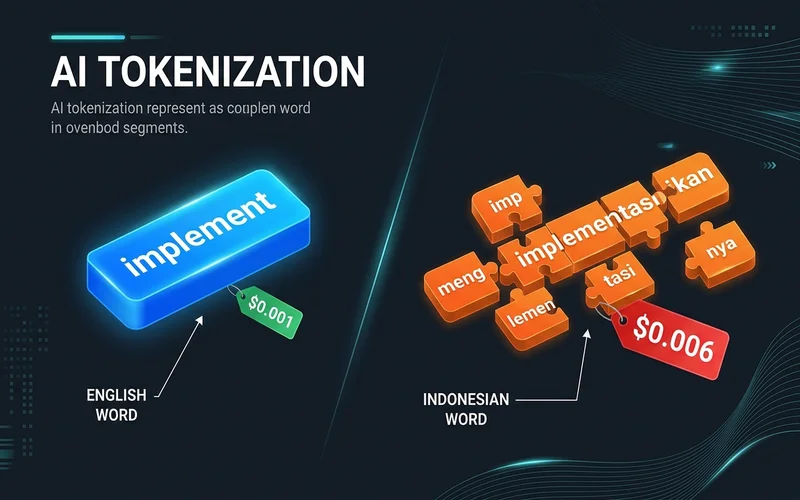
One of the most overlooked efficiency bottlenecks in non-English engineering teams is Byte-Pair Encoding (BPE) token inflation.
Large language model tokenizers are trained predominantly on English code and text. In English, one word typically translates into a single token:
"environment"= 1 token"architecture"= 1 token
In Bahasa Indonesia or other languages, the tokenizer splits common words into multiple sub-tokens:
"lingkungan"="ling"+"kung"+"an"(3 tokens)"mengimplementasikan"="meng"+"im"+"ple"+"men"+"tasi"+"kan"(6 tokens)
Important
The Cost & Speed Consequence: Writing system prompts, code comments, or architectural rules in Indonesian fills the agent's desk 2x to 3x faster, resulting in higher API billing and premature context forgetting.
The Golden Bilingual Strategy:
- Write Rules & Blueprints in English: Keep
AGENTS.md,.agents/rules/, function names, database schemas, and git commit logs in English for 0% token waste and maximum precision. - Chat & Discuss in Your Native Language: Converse freely, brainstorm, review executive summaries, and ask diagnostic questions in Bahasa Indonesia.
3. Tripartite Governance Architecture: Constitution, SOPs, and Tools
A production workspace should never cram all instructions into a single gargantuan prompt. This causes prompt dilution, where the model ignores critical rules in favor of whatever text happens to appear near the end.
Instead, Antigravity uses a decoupled, three-tier governance hierarchy:
┌───────────────────────────────────────────────────────────────────────────┐
│                    TRIPARTITE GOVERNANCE ARCHITECTURE                     │
│                                                                           │
│  Level 1: The Constitution (`AGENTS.md`)                                  │
│  - Permanent global rules that stay on the desk 24/7.                     │
│  - Identity, operating environment, planning mode mandate, safety boundaries.│
│                                                                           │
│  Level 2: Department SOP Binders (`.agents/rules/*.md`)                   │
│  - Focused, modular rules loaded only when touching specific subsystems.  │
│  - e.g. `rules/database.md`, `rules/statutory_tax.md`, `rules/ui_tokens.md` │
│                                                                           │
│  Level 3: Power Tools (`.agents/skills/*/SKILL.md`)                       │
│  - Standalone, executable scripts and deterministic CLI utilities.         │
│  - Prevents math hallucinations by handing work to deterministic Python.  │
└───────────────────────────────────────────────────────────────────────────┘
4. Frontier LLM Selection Matrix & Workload Tiering
Autonomous engineering systems must route tasks dynamically based on complexity, reasoning depth, and latency tolerance:
| Model ID | Context Window | Best Suited Role in Workspace | Recommended Sampling Parameters |
|---|---|---|---|
| Google Gemini 3.7 Flash | 1M – 2M Tokens | Primary Architecture & Coding Workhorse: End-to-end full-stack feature delivery, multi-file inspection, rapid tool execution. | temperature: 0.15, top_p: 0.95, top_k: 40 |
| Google Gemini 3.1 Pro Preview | 1M – 2M Tokens | Deep Mathematical & Tax True-Up Reasoning: Complex annual reconciliation math, multi-schema entity mapping, statutory audits. | temperature: 0.10, top_p: 0.95, top_k: 40 |
| Claude 3.7 Sonnet (Hybrid Think) | 200K Tokens | Autonomous Refactoring Loops: Multi-turn debugging, deep bug fixing, and adversarial code reviews with extended reasoning budgets. | temperature: 0.20, thinking_budget: 8192 |
| Local Ollama DeepSeek-R1 / Qwen 2.5 | 64K – 128K Tokens | Air-Gapped Private Execution: Processing proprietary credentials, customer payroll NIKs, and banking flat files on local hardware. | temperature: 0.10, num_ctx: 65536 |
5. The Three Golden Execution Laws
To prevent agents from introducing silent regressions or breaking working systems, enforce these three non-negotiable laws in your AGENTS.md:
Law 1: The Blueprint Law & Test-Driven Scaffolding
Never permit an agent to write implementation code without an approved plan.
When a task involves more than a trivial one-line fix, the agent must enter Planning Mode, thoroughly inspect existing dependencies, write an implementation_plan.md artifact, and wait for explicit human approval. Furthermore, tests must be written first to capture intended behavior before code modification begins.
Law 2: Builder vs. Adversarial Auditor (Eliminating Confirmation Bias)
When an agent writes code and tests its own work, it suffers from severe confirmation bias: it inherently tests the "happy path" it designed.
Solve this by spawning an independent subagent (invoke_subagent) acting as an adversarial auditor whose explicit prompt is to break the implementation, test boundary edge cases, check SQL injection surfaces, and audit memory limits.
Law 3: Safe Triage & Permanent Root Cause Analysis (RCA) Dossiers
When unexpected crashes or bugs occur, prohibit agents from making speculative code edits. Enforce read-only safe triage:
- Inspect logs and reproduce the issue with zero file edits.
- Formulate a Root Cause Analysis (RCA) document detailing the failure mechanism.
- Apply the targeted fix.
- Verify resolution via deterministic command-line checks.
- Record findings in a persistent stability dossier (
SYSTEM_STABILITY_DOSSIER.md) to ensure future agents never repeat the same mistake.
6. Real-World Case Study: Resolving a Linux 6.12 Kernel PCIe Race
To understand how autonomous agent governance operates under pressure, consider this actual production case study from our engineering workspace:
The Incident
A development laptop running Linux 6.12 kernel experienced spontaneous system freezes at idle. Initial suspicion pointed to RAM defects or thermal throttling.
Autonomous Triage & Multi-Model Delegation
- An initial triage subagent performed read-only inspection of
journalctl, isolating a PCIe CNVio bus power-management race condition involving theiwlwifiwireless driver and TLP power-saving settings (RFIm reason=4,0x0BADCAFE). - Multiple model opinions were synthesized:
- Claude 3.7 Sonnet identified a direct conflict between TLP battery power saving and kernel driver parameters.
- Gemini 3.7 Flash designed a multi-phase rollback and verification plan.
- Instead of blindly modifying
/etc/default/grub, the agent constructed an isolated systemd watchdog service (iwlwifi-watchdog.service) and created a persistentSYSTEM_STABILITY_DOSSIER.mdtracking kernel boot outcomes. - The system achieved 100% stability with verified telemetry snapshots recorded automatically.
Conclusion
Autonomous AI agents do not replace software engineering discipline; they amplify it. By treating the agent as a brilliant but directionless intern, conserving tokens with strict bilingual prompting, modularizing governance rules, and demanding deterministic test verification, engineering teams can build reliable, enterprise-grade software at unprecedented speed.